Art From the Indian Mughal Period Incorporated Visual Elements From Both Europe and

Mughal painting is a detail style of S Asian, particularly North Indian (more specifically, modernistic day India and Pakistan), painting confined to miniatures either as volume illustrations or as single works to be kept in albums (muraqqa). It emerged from Persian miniature painting (itself partly of Chinese origin) and developed in the court of the Mughal Empire of the 16th to 18th centuries. Battles, legendary stories, hunting scenes, wildlife, royal life, mythology, besides as other subjects have all been ofttimes depicted in paintings.[i]
The Mughal emperors were Muslims and they are credited with consolidating Islam in Southward Asia, and spreading Muslim (and specially Persian) arts and culture every bit well as the faith.[2]
Mughal painting immediately took a much greater interest in realistic portraiture than was typical of Persian miniatures. Animals and plants were the main subject area of many miniatures for albums, and were more realistically depicted. Although many classic works of Western farsi literature connected to exist illustrated, also as Indian works, the sense of taste of the Mughal emperors for writing memoirs or diaries, begun past Babur, provided some of the most lavishly decorated texts, such equally the Padshahnama genre of official histories. Subjects are rich in variety and include portraits, events and scenes from court life, wild life and hunting scenes, and illustrations of battles. The Persian tradition of richly busy borders framing the central image (mostly trimmed in the images shown hither) was continued, every bit was a modified class of the Persian convention of an elevated viewpoint.

The Emperor Shah Jahan standing on a globe, with a halo and European-style putti, c. 1618–19 to 1629.
The Mughal painting style later on spread to other Indian courts, both Muslim and Hindu, and afterward Sikh, and was often used to depict Hindu subjects. This was by and large in northern India. It developed many regional styles in these courts, tending to become bolder but less refined. These are often described as "mail-Mughal", "sub-Mughal" or "provincial Mughal". The mingling of foreign Persian and indigenous Indian elements was a continuation of the patronage of other aspects of foreign culture every bit initiated by the earlier Turko-Afghan Delhi Sultanate, and the introduction of information technology into the subcontinent by diverse Central Asian Turkish dynasties, such equally the Ghaznavids.
Subjects [edit]
Portraits [edit]

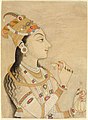
From adequately early the Mughal style made a strong feature of realistic portraiture, normally in profile, and influenced by Western prints, which were available at the Mughal court. This had never been a feature of either Farsi miniature or earlier Indian painting. The pose, rarely varied in portraits, was to take the head in strict profile, just the residue of the trunk half turned towards the viewer. For a long time portraits were always of men, often accompanied by generalized female servants or concubines; but there is scholarly fence almost the representation of female courtroom members in portraiture. Some scholars claim at that place are no known extant likenesses of figures similar Jahanara Begum and Mumtaz Mahal, and others attribute miniatures, for example from the Dara Shikoh album or the Freer Gallery of Art mirror portrait, to these famous noblewomen.[3] [4] [v] The single idealized figure of the Riza Abbasi type was less popular, but fully painted scenes of lovers in a palace setting became popular later on. Drawings of genre scenes, especially showing holy men, whether Muslim or Hindu, were also pop.
Akbar had an anthology, now dispersed, consisting entirely of portraits of figures at his enormous court which had a practical purpose; co-ordinate to chroniclers he used to consult information technology when discussing appointments and the like with his advisors, apparently to jog his memory of who the people being discussed were. Many of them, similar medieval European images of saints, carried objects associated with them to help identification, but otherwise the figures stand on a manifestly groundwork.[6] There are a number of fine portraits of Akbar, but it was under his successors Jahangir and Shah Jahan that the portrait of the ruler became firmly established as a leading bailiwick in Indian miniature painting, which was to spread to both Muslim and Hindu princely courts across India.[vii]
From the 17th century equestrian portraits, mostly of rulers, became another popular borrowing from the West.[viii] Another new type of image showed the Jharokha Darshan (literally "balustrade view/worship"), or public brandish of the emperor to the courtroom, or the public, which became a daily ceremonial under Akbar, Jahangir and Shah Jahan, earlier being stopped as un-Islamic by Aurangzeb. In these scenes, the emperor is shown at elevation on a balcony or at a window, with a oversupply of courtiers below, sometimes including many portraits. Like the increasingly large halos these emperors were given in unmarried portraits, the iconography reflects the aspiration of the afterwards Mughals to project an prototype equally the representative of Allah on earth, or fifty-fifty as having a quasi-divine status themselves.[9] [10] Other images testify the enthroned emperor having meetings, receiving visitors, or in durbar, or formal council. These and royal portraits incorporated in hunting scenes became highly popular types in later Rajput painting and other post-Mughal styles.
Animals and plants [edit]
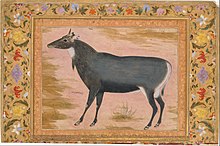
Nilgai past Ustad Mansur (fl. 1590–1624), who specialized in birds and animal studies for albums.
Another popular bailiwick area was realistic studies of animals and plants, more often than not flowers; the text of the Baburnama includes a number of descriptions of such subjects, which were illustrated in the copies made for Akbar. These subjects also had specialist artists, including Ustad Mansur. Milo C. Embankment argues that "Mughal naturalism has been greatly overstressed. Early animate being imagery consists of variations on a theme, rather than new, innovative observations". He sees considerable borrowings from Chinese animal paintings on paper, which seem not to have been highly valued past Chinese collectors, and then reached India.[xi]
Illustrated books [edit]
In the formative period of the style, under Akbar, the royal workshop produced a number of heavily illustrated copies of established books in Western farsi. One of the outset, probably from the 1550s and at present mostly in the Cleveland Museum of Art, was a Tutinama with some 250 rather elementary and rather small miniatures, nearly with but a few figures. In dissimilarity the Hamzanama Akbar commissioned had unusually large pages, of densely woven cotton rather than the usual newspaper, and the images were very often crowded with figures. The work was "a continuous serial of romantic interludes, threatening events, narrow escapes, and violent acts", supposedly telling the life of an uncle of Muhammad.[12] Akbar's manuscript had a remarkable total of some 1400 miniatures, one on every opening, with the relevant text written on the back of the folio, presumably to be read to the emperor as he looked at each paradigm. This colossal project took most of the 1560s, and probably beyond. These and a few other early works saw a fairly unified Mughal workshop fashion emerge by around 1580.
Other big projects included biographies or memoirs of the Mughal dynasty. Babur, its founder, had written classic memoirs, which his grandson Akbar had translated into Persian, as the Baburnama (1589), and so produced in four lavishly illustrated copies, with upward to 183 miniatures each. The Akbarnama was Akbar's ain commissioned biography or chronicle, produced in many versions, and the tradition connected with Jahangir's autobiography Tuzk-e-Jahangiri (or Jahangirnama) and a celebratory biography of Shah Jahan, called the Padshahnama, which brought the era of the large illustrated regal biography to an finish, around 1650. Akbar commissioned a copy of the Zafarnama, a biography of his distant ancestor Timur, but though he had his aunt write a biography of his father Humayun, no illustrated manuscript survives.
Volumes of the classics of Persian verse usually had rather fewer miniatures, often around twenty, merely oft these were of the highest quality. Akbar as well had the Hindu epic poems translated into Western farsi, and produced in illustrated versions. Four are known of the Razmnama, a Mahabharata in Persian, from between 1585 and c. 1617. Akbar had at least one copy of the Persian version of the Ramayana.
Origins [edit]
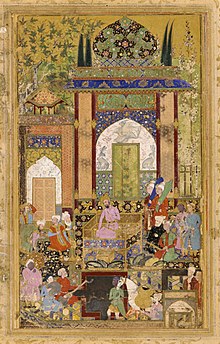
Mughal court painting, every bit opposed to looser variants of the Mughal style produced in regional courts and cities, drew picayune from indigenous not-Muslim traditions of painting. These were Hindu and Jain, and earlier Buddhist, and almost entirely religious. They existed mainly in relatively small illustrations to texts, but also mural paintings, and paintings in folk styles on fabric, in particular ones on scrolls fabricated to be displayed by popular singers or reciters of the Hindu epics and other stories, performed by travelling specialists; very few early examples of these final survive. A vivid Kashmiri tradition of mural paintings flourished betwixt the 9th and 17th centuries, every bit seen in the murals of Alchi Monastery or Tsaparang: a number of Kashimiri painters were employed by Akbar and some influence of their art can be seen in various Mughal works, such every bit the Hamzanama.[xiii]
In contrast Mughal painting was "almost entirely secular",[fourteen] although religious figures were sometimes portrayed. Realism, peculiarly in portraits of both people and animals, became a key aim, far more in Persian painting, let alone the Indian traditions.[15] There was already a Muslim tradition of miniature painting nether the Turko-Afghan Sultanate of Delhi which the Mughals overthrew, and like the Mughals, and the very earliest of Central Asian invaders into the subcontinent, patronized strange culture. These paintings were painted on loose-leaf paper, and were usually placed between busy wooden covers.[16] Although the commencement surviving manuscripts are from Mandu in the years either side of 1500, there were very probable earlier ones which are either lost, or perhaps now attributed to southern Persia, as later manuscripts tin can be hard to distinguish from these past style alone, and some remain the discipline of debate among specialists.[17] By the fourth dimension of the Mughal invasion, the tradition had abased the high viewpoint typical of the Persian style, and adopted a more realistic manner for animals and plants.[18]
No miniatures survive from the reign of the founder of the dynasty, Babur, nor does he mention commissioning any in his memoirs, the Baburnama.[19] Copies of this were illustrated by his descendents, Akbar in particular, with many portraits of the many new animals Babur encountered when he invaded Bharat, which are carefully described.[20] However some surviving un-illustrated manuscripts may have been commissioned past him, and he comments on the fashion of some famous past Persian masters. Some older illustrated manuscripts take his seal on them; the Mughals came from a long line stretching back to Timur and were fully assimilated into Persianate civilization, and expected to patronize literature and the arts.
The fashion of the Mughal school developed inside the royal atelier. Noesis was primarily transmitted through familial and apprenticeship relationships, and the system of joint manuscript production which brought multiple artists together for single works.[21] In some cases, senior artists would draw the illustrations in outline, and more junior ones would usually apply the colours, especially for background areas.[22] Where no artist names are inscribed, it is very difficult to trace Imperial Mughal paintings dorsum to specific artists.[23]
Development [edit]

Princes of the House of Timur, attributed to the Persian Abd as-Samad, c. 1550–1555, with additions in the side by side century under Jahangir.[24]
After a tentative showtime under Humayun, the keen period of Mughal painting was during the next 3 reigns, of Akbar, Jahangir and Shah Jahan, which covered merely over a century betwixt them.
Humayun (1530–1540 and 1555–1556) [edit]
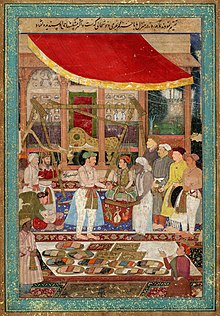
Emperor Jahangir weighs Prince Khurram by Manohar Das, 1610–15, from Jahangir'due south own copy of the Tuzk-due east-Jahangiri. The names of the principal figures are noted on their clothes, and the artist shown at bottom. British Museum
When the second Mughal emperor, Humayun was in exile in Tabriz in the Safavid court of Shah Tahmasp I of Persia, he was exposed to Farsi miniature painting, and commissioned at to the lowest degree one piece of work at that place (or in Kabul), an unusually big painting on cloth of Princes of the House of Timur, now in the British Museum. Originally a group portrait with his sons, in the next century Jahangir had it added to make it a dynastic group including expressionless ancestors.[25] When Humayun returned to India, he brought two accomplished Persian artists Abd al-Samad and Mir Sayyid Ali with him. His usurping brother Kamran Mirza had maintained a workshop in Kabul, which Humayan perchance took over into his own. Humayan's major known commission was a Khamsa of Nizami with 36 illuminated pages, in which the different styles of the various artists are mostly still apparent.[26] Autonomously from the London painting, he besides deputed at least two miniatures showing himself with family unit members,[27] a type of subject that was rare in Persia just mutual among the Mughals.[28]
Akbar (r. 1556–1605) [edit]
During the reign of Humayun's son Akbar (r. 1556–1605), the purple court, apart from being the eye of administrative authority to manage and rule the vast Mughal empire, also emerged as a centre of cultural excellence. Akbar inherited and expanded his father's library and atelier of court painters, and paid close personal attending to its output. He had studied painting in his youth under Abd as-Samad, though it is not clear how far these studies went.[29]
Between 1560 and 1566 the Tutinama ("Tales of a Parrot"), now in the Cleveland Museum of Fine art was illustrated, showing "the stylistic components of the imperial Mughal fashion at a formative stage".[30] Amidst other manuscripts, between 1562 and 1577 the atelier worked on an illustrated manuscript of the Hamzanama consisting of 1,400 cotton folios, unusually large at 69 cm x 54 cm (approx. 27 x twenty inches) in size. This huge project "served equally a means of moulding the disparate styles of his artists, from Islamic republic of iran and from different parts of India, into one unified style". By the end, the manner reached maturity, and "the apartment and decorative compositions of Persian painting take been transformed past creating a conceivable space in which characters painted in the round can perform".[31]
Sa'di's masterpiece The Gulistan was produced at Fatehpur Sikri in 1582, a Darab Nama around 1585; the Khamsa of Nizami (British Library, Or. 12208) followed in the 1590s and Jami's Baharistan around 1595 in Lahore. Equally Mughal-derived painting spread to Hindu courts the texts illustrated included the Hindu epics including the Ramayana and the Mahabharata; themes with animal fables; individual portraits; and paintings on scores of different themes. Mughal style during this menses continued to refine itself with elements of realism and naturalism coming to the fore. Between 1570–1585, Akbar hired over ane hundred painters to practice Mughal style painting.[32]
Akbar'south rule established a celebratory theme among the Mughal Empire. In this new period, Akbar persuaded artist to focus on showing off spectacles and including 1000 symbols like elephants in their work to create the sense of a prospering empire. Along with this new mindset, Akbar also encouraged his people to write downward and discover a style to record what they remembered from earlier times to ensure that others would be able to remember the greatness of the Mughal empire. [33] [34]
Jahangir (1605–1625) [edit]
Jahangir had an creative inclination and during his reign Mughal painting developed farther. Brushwork became effectively and the colours lighter. Jahangir was also deeply influenced by European painting. During his reign he came into direct contact with the English Crown and was sent gifts of oil paintings, which included portraits of the Rex and Queen. He encouraged his royal atelier to take up the unmarried point perspective favoured by European artists, unlike the flattened multi-layered style used in traditional miniatures. He particularly encouraged paintings depicting events of his ain life, individual portraits, and studies of birds, flowers and animals. The Tuzk-e-Jahangiri (or Jahangirnama), written during his lifetime, which is an autobiographical account of Jahangir's reign, has several paintings, including some unusual subjects such as the union of a saint with a tigress, and fights between spiders.[ citation needed ] Mughal paintings made during Jahangir's reign continued the trend of Naturalism and were influenced past the resurgence of Persian styles and subjects over more than traditional Hindu.[35]
Shah Jahan (1628–1659) [edit]
During the reign of Shah Jahan (1628–58), Mughal paintings connected to develop, but court paintings became more rigid and formal. The illustrations from the "Padshanama" (chronicle of the Rex of the world), one of the finest Islamic manuscripts from the Royal Collection, at Windsor, were painted during the reign of Shah Jahan. Written in Persian on paper that is flecked with gold, has exquisitely rendered paintings. The "Padshahnama" has portraits of the courtiers and servants of the Rex painted with bully particular and individuality. In keeping with the strict formality at courtroom, withal the portraits of the King and important nobles was rendered in strict contour, whereas servants and common people, depicted with individual features have been portrayed in the three-quarter view or the frontal view.
Themes including musical parties; lovers, sometimes in intimate positions, on terraces and gardens; and ascetics gathered around a fire, grow in the Mughal paintings of this period.[36] [ citation needed ] Even though this period was titled the near prosperous, artists during this fourth dimension were expected to adhere to representing life in courtroom as organized and unified. For this reason, near fine art created under his rule focused mainly on the emperor and aided in establishing his authority. The purpose of this art was to exit behind an image of what the Mughal's believed to be the platonic ruler and state.[37]
Afterwards paintings [edit]

A durbar scene with the newly crowned Emperor Aurangzeb in his golden throne. Though he did not encourage Mughal painting, some of the best work was done during his reign.
Aurangzeb (1658–1707) was never an enthusiastic patron of painting, largely for religious reasons , and took a plough abroad from the pomp and ceremonial of the court around 1668, after which he probably commissioned no more paintings. Subsequently 1681 he moved to the Deccan to pursue his slow conquest of the Deccan Sultanates, never returning to live in the due north.[38]
Mughal paintings connected to survive, but the decline had set in. Some sources still annotation that a few of the best Mughal paintings were fabricated for Aurangzeb, speculating that they believed that he was about to close the workshops and thus exceeded themselves in his behalf.[39] There was a brief revival during the reign of Muhammad Shah 'Rangeela' (1719–48), just by the time of Shah Alam Ii (1759–1806), the art of Mughal painting had lost its glory. By that fourth dimension, other schools of Indian painting had developed, including, in the royal courts of the Rajput kingdoms of Rajputana, Rajput painting and in the cities ruled by the British East India Company, the Company style nether Western influence. Late Mughal style oft shows increased employ of perspective and recession nether Western influence.
Many museums take collections, with that of the Victoria and Albert Museum in London particularly large.[40]
Artists [edit]
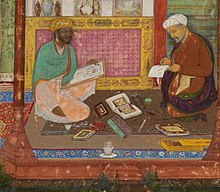
The Persian master artists Abd al-Samad and Mir Sayyid Ali, who had accompanied Humayun to India in the 16th century, were in charge of the imperial atelier during the formative stages of Mughal painting. Many artists worked on big commissions, the majority of them apparently Hindu, to judge past the names recorded. Mughal painting more often than not involved a group of artists, one (generally the nigh senior) to decide and outline the limerick, the second to actually paint, and perhaps a third who specialized in portraiture, executing individual faces.[41]
This was especially the case with the large historical book projects that dominated production during Akbar's reign, the Tutinama, Baburnama, Hamzanama, Razmnama, and Akbarnama. For manuscripts of Western farsi poetry there was a unlike fashion of working, with the best masters obviously expected to produce exquisitely finished miniatures all or largely their own piece of work.[42] An influence on the evolution of mode during Akbar'due south reign was Kesu Das, who understood and developed "European techniques of rendering space and book".[43]
Conveniently for modern scholars, Akbar liked to meet the names of the artists written below each miniature. Analysis of manuscripts shows that individual miniatures were assigned to many painters. For example, the incomplete Razmnama in the British Library contains 24 miniatures, with 21 dissimilar names, though this may exist an peculiarly large number.[44]
Other important painters under Akbar and Jahangir were:[45]
- Farrukh Beg (c. 1545– c. 1615), another Persian import, in India from 1585–1590, possibly then in Bijapur, returning due north from around 1605 to his death.
- Daswanth, a Hindu, d. 1584, who worked especially on Akbar'south Razmnama, the Mahabharata in Farsi
- Basawan a Hindu active c. 1580–1600, whose son Manohar Das was active c. 1582–1624
- Govardhan, active c. 1596 to 1640, some other Hindu, especially good at portraits. His father Bhavani Das,[37] had been a painter in the regal workshop.
- Ustad Mansur (flourished 1590–1624) a specialist in animals and plants
- Abu al-Hasan (1589 – c. 1630), maybe the son of Reza Abbasi, the leading Persian painter of his generation.
- Bichitr
- Bishandas, a Hindu specialist in portraits
- Mushfiq an early case of an artist who seems never to have worked in the imperial atelier, just for other clients.
- Miskin
Others: Nanha, Daulat, Payag, Abd al-Rahim, Amal-e Hashim, Keshavdas, and Mah Muhammad.
The sub-majestic school of Mughal painting included artists such as Mushfiq, Kamal, and Fazl. During the first half of the 18th century, many Mughal-trained artists left the imperial workshop to piece of work at Rajput courts. These include artists such every bit Bhawanidas and his son Dalchand.
Mughal style today [edit]
Mughal-style miniature paintings are still being created today by a small number of artists in Lahore concentrated mainly in the National College of Arts. Although many of these miniatures are skillful copies of the originals, some artists accept produced contemporary works using classic methods with, at times, remarkable artistic consequence.
The skills needed to produce these modern versions of Mughal miniatures are nonetheless passed on from generation to generation, although many artisans also employ dozens of workers, oft painting nether trying working conditions, to produce works sold under the signature of their mod masters.
Gallery [edit]
-

Portrait of Akbar
-
-
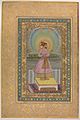
Shah Jahan on a terrace holding a pendant gear up with his portrait
-
-

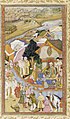
The Submission of the rebel brothers Ali Quli and Bahadur Khan. Akbarnama, 1590–95[46]
-

Akbar riding the elephant Hawa'I pursuing another elephant beyond a collapsing bridge of boats (right), 1561
-

Pir Muhammad Drowns While Crossing the Narbada-Akbarnama, 1562
-

Alexander is Lowered into the Sea, from a Khamsa (Quintet) of Amir Khusrau Dihlavi c. 1597–98, attributed to Mukanda.[47]
-

Mughal Prince visits a Holy Man
-

A Mughal prince and ladies in a garden, 18th century
-

A young adult female playing a Veena to a parakeet, a symbol of her absent lover. 18th-century painting in the provincial Mughal style of Bengal
-
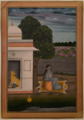
Ascetic Seated on Leopard'south Skin, late 18th century
-
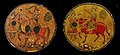
Mughal Ganjifa playing cards, early 19th century, with miniature paintings – courtesy of the Wovensouls collection
-

The figural decoration of this example shows a stiff relationship to paintings of the 17th century.[49]
Encounter also [edit]
- Arabic miniature
- Indian painting
- Madhubani painting
- Ottoman miniature
- Rajput painting
- Tanjore painting
- Western painting
- Persian miniature
- Islamic miniature
Notes [edit]
- ^ Ali, Azmat; Sahni, Janmejay; Sharma, Mohit; Sharma, Prajjwal; Goel, Dr Priya (2019-11-12). IAS Mains Newspaper 1 Indian Heritage & Culture History & Geography of the world & Society 2020. Arihant Publications Republic of india limited. ISBN978-93-241-9210-3.
- ^ "BBC - Religions - Islam: Mughal Empire (1500s, 1600s)". www.bbc.co.uk . Retrieved 2019-01-01 .
- ^ Crill and Jariwala, 23-30
- ^ Losty, J.P.; Roy, Malini (2012). Mughal Republic of india: Fine art, Civilisation and Empire Manuscripts and Paintings in the British Library. London: The British Library. pp. 132–133. ISBN9780712358705.
- ^ Abid. Reign of Shah Jahan, portrait by Abid dated 1628; assembled late 17th century. Mirror Case With Portrait of Mumtaz Mahal. Freer Gallery of Art. F2005.four [i]
- ^ Crill and Jariwala, 66
- ^ Crill and Jariwala, 27–39, and catalogue entries
- ^ Crill and Jariwala, 68
- ^ Hansen, Waldemar, The Peacock Throne: The Drama of Mogul India, 102, 1986, Motilal Banarsidass ISBN 978-81-208-0225-four
- ^ Kaur, Manpreet (February 2015). "Romancing The Jharokha: From Existence A Source Of Ventilation And Light To The Divine Conception" (PDF). International Journal of Informative & Futuristic Research.
- ^ Beach, 32–37, 37 quoted
- ^ Embankment, 61
- ^ Chaitanya, Krishna (1976). A History of Indian Painting. Abhinav Publications. pp. 6–seven.
- ^ Harle, 372
- ^ Harle, 372
- ^ Seyller, John (1999). "Workshop and Patron in Mughal Bharat: The Freer Rāmāyaṇa and Other Illustrated Manuscripts of 'Abd al-Raḥīm". Artibus Asiae. Supplementum. 42: 3–344. ISSN 1423-0526. JSTOR 1522711.
- ^ Titley, 161–166
- ^ Titley, 161
- ^ Losty, 12
- ^ Titley, 187
- ^ Sarafan, Greg (half dozen November 2011). "Artistic Stylistic Transmission in the Royal Mughal Atelier". Sensible Reason.
- ^ Seyller, John (1999). "Workshop and Patron in Mughal Republic of india: The Freer Rāmāyaṇa and Other Illustrated Manuscripts of 'Abd al-Raḥīm". Artibus Asiae. Supplementum. 42: 3–344. ISSN 1423-0526. JSTOR 1522711.
- ^ Seyller, John (1999). "Workshop and Patron in Mughal India: The Freer Rāmāyaṇa and Other Illustrated Manuscripts of 'Abd al-Raḥīm". Artibus Asiae. Supplementum. 42: 3–344. ISSN 1423-0526. JSTOR 1522711.
- ^ Crill and Jariwala, 50
- ^ Crill and Jariwala, l
- ^ Grove
- ^ Grove
- ^ Beach, 58
- ^ Embankment, 49
- ^ Grove
- ^ Losty, 15
- ^ Eastman
- ^ Ebba Koch, Visual Strategies of Imperial Self-Representation:The Windsor Pādshāhnāma Revisited
- ^ Koch, Ebba. "Visual Strategies of Majestic Self-Representation:The Windsor Pādshāhnāma Revisited". Fine art Message.
- ^ Seyller, John (1999). "Workshop and Patron in Mughal India: The Freer Rāmāyaṇa and Other Illustrated Manuscripts of 'Abd al-Raḥīm". Artibus Asiae. Supplementum. 42: 3–344. ISSN 1423-0526. JSTOR 1522711.
- ^ Britannica
- ^ a b Singh, Kavita (thirteen June 2021). "In a resplendent portrait of a Mughal emperor, subtle clues nigh a dark fall". Scroll.in . Retrieved 2021-06-thirteen .
{{cite web}}: CS1 maint: url-status (link) - ^ Losty, 147, 149
- ^ Commentary by Stuart Cary Welch
- ^ "Five&A · Near us". Victoria and Albert Museum . Retrieved 2022-02-17 .
- ^ Losty, 31; Crill and Jariwala, 27; Britannica
- ^ Losty, 31
- ^ Bloom, Jonathan One thousand.; Blair, Sheila S. (2009). The Grove Encyclopedia of Islamic Art and Architecture. Vol. one. Oxford University Press. p. 380. ISBN978-0-19-530991-1.
- ^ "Razmnamah: the Persian Mahabharata", British Library Asian and African studies blog, by Ursula Sims-Williams, April 2016 - see table nearly bottom
- ^ Diamind, Maurice. "Mughal Painting Under Akbar the Neat" Metropolitan Museum of Fine art
- ^ Basawan & Chitra (1590–1595). "The Submission of the rebel brothers Ali Quli and Bahadur Khan-Akbarnama". Akbarnama.
- ^ "Alexander is Lowered into the Sea". world wide web.metmuseum.org . Retrieved 2018-12-14 .
- ^ Smart, Ellen (1999). "The Death of Ināyat Khān past the Mughal Artist Bālchand". Artibus Asiae. Supplementum. 58: 273–279. ISSN 1423-0526. JSTOR 3250020.
- ^ "Box with Scenes of an Emperor Receiving Gifts, early to mid-17th century". www.metmuseum.org . Retrieved 2018-12-17 .
References [edit]
- Beach, Milo Cleveland, Early Mughal painting, Harvard University Press, 1987, ISBN 0-674-22185-0, ISBN 978-0-674-22185-7, google books
- Crill, Rosemary, and Jariwala, Kapil. The Indian Portrait, 1560–1860, National Portrait Gallery, London, 2010, ISBN 9781855144095
- Eastman, Alvan C. "Mughal painting." College Art Association . iii.ii (1993): 36. Spider web. 30 Sep. 2013.
- "Grove", Oxford Art Online, "Indian sub., §Six, 4(i): Mughal ptg styles, 16th–19th centuries", restricted access.
- Harle, J.C., The Art and Compages of the Indian Subcontinent, 2nd edn. 1994, Yale Academy Printing Pelican History of Fine art, ISBN 0300062176
- Kossak, Steven. (1997). Indian court painting, 16th-19th century. Metropolitan Museum of Art. ISBN 0870997831
- Losty, J. P. Roy, Malini (eds), Mughal India: Art, Culture and Empire, 2013, British Library, ISBN 0712358706, 9780712358705
- "Mughal Painting." Encyclopædia Britannica. Encyclopædia Britannica Bookish Online Edition. Encyclopædia Britannica Inc., 2013.Web. 30 Sep 2013.
- Titley, Norah G., Persian Miniature Painting, and its Influence on the Art of Turkey and Bharat, 1983, University of Texas Press, 0292764847
- Sarafan, Greg, "Artistic Stylistic Transmission in the Royal Mughal Atelier", Sensible Reason, LLC, 2007, SensibleReason.com
Farther reading [edit]
- Painting for the Mughal Emperor (The Art of the Book 1560-1660) by Susan Stronge (ISBN 0-8109-6596-viii)
- Fiction in Mughal Miniature Painting by Prof. P. C. Jain and Dr. Daljeet
- Painting the Mughal Feel by Som Prakash Verma, 2005 (ISBN 0-xix-566756-5)
- Chitra, Die Tradition der Miniaturmalerei in Rajasthan past K.D. Christof & Renate Haass, 1999 (ISBN 978-iii-89754-231-0)
- Welch, Stuart Cary; et al. (1987). The Emperors' album: images of Mughal India . New York: The Metropolitan Museum of Art. ISBN978-0870994999.
- Welch, Stuart Cary (1985). India: art and civilization, 1300-1900 . New York: The Metropolitan Museum of Art. ISBN9780944142134.
- Creative Stylistic Transmission in the Regal Mughal Atelier by Greg Sarafan, Esq., 2007
External links [edit]
- Indian Courtroom Painting, 16th-19th Century from the Metropolitan Museum of Art
- National Museum, Delhi - Mughal paintings
- San Diego Museum of Fine art
- Collection: Art of the Mughal Empire from the University of Michigan Museum of Art
robertsablets1978.blogspot.com
Source: https://en.wikipedia.org/wiki/Mughal_painting
0 Response to "Art From the Indian Mughal Period Incorporated Visual Elements From Both Europe and"
Enviar um comentário